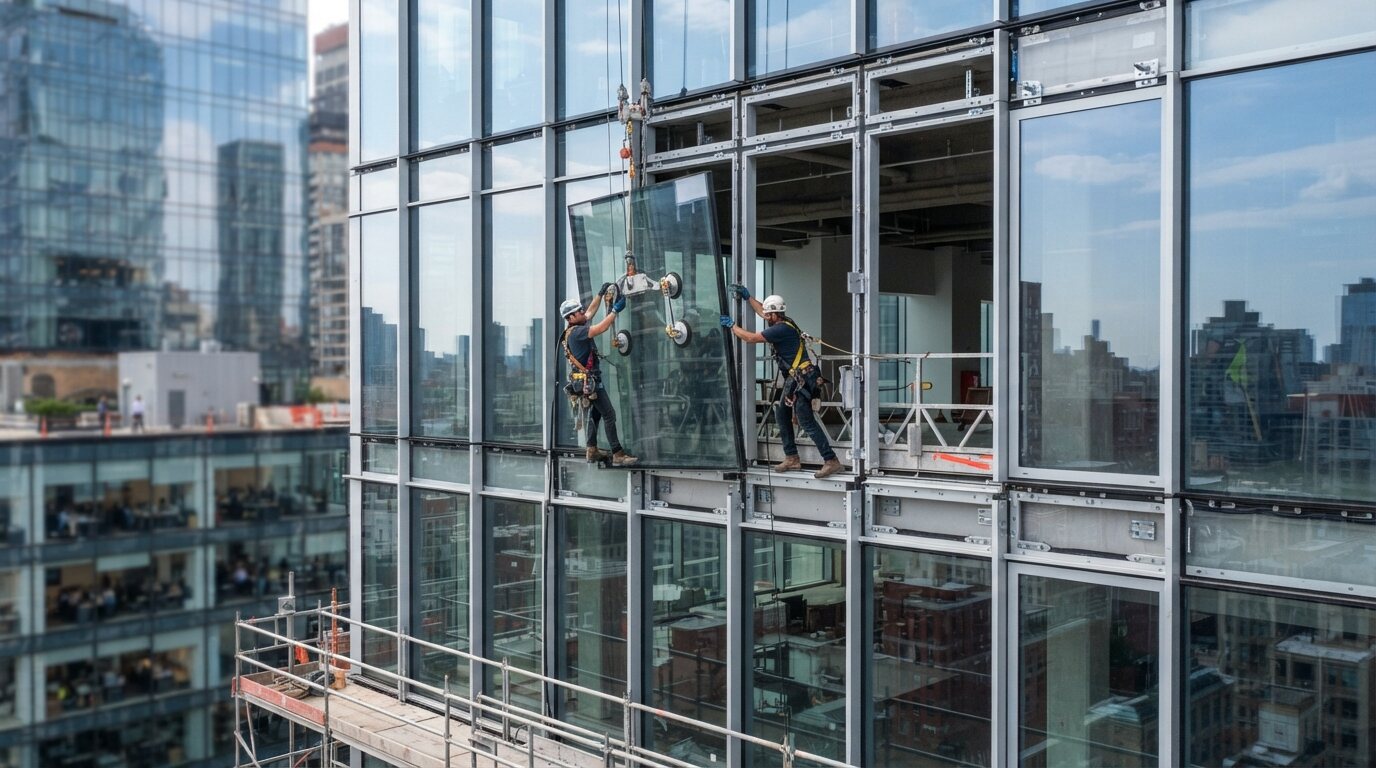
When sourcing high-performance glass, complex facade systems, or advanced curtain walls for your next project, China’s Guangdong province offers unparalleled capabilities. Specifically, the cities of Dongguan and Shenzhen stand out as critical hubs. Dongguan, with its robust manufacturing infrastructure, is a powerhouse for glass processing, while neighboring Shenzhen leads in sophisticated facade engineering and the production of advanced systems like unitised curtain walls.
For international buyers, these two cities provide access to a comprehensive supply chain, from basic processed glass to complete, custom-engineered facade solutions. Whether you are a villa owner looking for high-quality windows, a developer planning a high-rise, or an importer needing reliable supply, understanding the strengths of these regions, particularly the expertise of Shenzhen curtain wall factories, is key to successful procurement.
Dongguan: Precision Glass Processing and Fabrication
Dongguan has long been a manufacturing heartland, and its glass industry is no exception. Here, you’ll find numerous factories specializing in transforming raw float glass into a wide array of functional and aesthetic products. These processors handle everything from basic tempering to complex laminations and insulated glass units (IGUs).
- Tempered Glass: Essential for safety, tempered glass is processed for increased strength (typically 4-5 times stronger than annealed glass) and shatters into small, blunt pieces when broken. Common thicknesses range from 4mm to 19mm, with maximum panel sizes often reaching 3.3m x 12m for large facade applications. Lead times for standard tempering are usually 10-15 days.
- Laminated Glass: This involves bonding two or more panes of glass with a plastic interlayer (PVB, SGP, EVA). It’s crucial for security, sound insulation, and UV protection. Thicknesses vary widely, from 6.38mm (3+3mm) to 40mm+ for bullet-resistant applications. Laminated glass is ideal for skylights, balustrades, and areas requiring enhanced safety.
- Insulated Glass Units (IGUs): Also known as double glazing, IGUs consist of two or more glass panes separated by a spacer, creating a sealed air or gas-filled space. This significantly improves thermal performance (U-value) and sound insulation. Factories in Dongguan can produce IGUs with various glass types, including low-E coatings, argon gas filling, and warm-edge spacers. Typical lead times are 15-25 days.
- Specialty Glass: This includes heat-strengthened glass (midway between annealed and tempered), curved glass for architectural features, digital ceramic frit glass for unique patterns, and various coated glass options (e.g., low-E for energy efficiency).
When sourcing from Dongguan, we always emphasize checking the quality of edge work, tempering consistency (no roller waves), and the cleanliness of the sealing for IGUs. Many factories here have advanced CNC cutting, grinding, and polishing equipment, ensuring high precision for complex shapes and sizes.
Shenzhen: The Hub for Advanced Facade Systems and Engineering
Shenzhen, known for its innovation and high-tech industries, is the preferred location for factories specializing in complex facade and curtain wall systems. This is where engineering expertise meets manufacturing capability, particularly for large-scale commercial and high-rise projects. The city’s proximity to Hong Kong also facilitates international business and logistics.
Unitised Curtain Wall Systems
One of Shenzhen’s key strengths is the production of unitised curtain wall systems. Unlike traditional stick-built systems assembled piece by piece on-site, unitised systems are fabricated and glazed into complete, interlocking panels in a factory-controlled environment. These panels are then transported to the site and rapidly installed onto the building structure. This approach offers several advantages:
- Speed of Installation: On-site installation is significantly faster, reducing overall project timelines and labor costs. A typical installation rate can be 100-200 sqm per day per crew, compared to 30-50 sqm for stick-built.
- Superior Quality Control: Factory assembly minimizes variables like weather conditions and site labor skill, leading to higher precision, better sealing, and fewer defects.
- Reduced Site Congestion: Less material storage and fewer workers are needed on the construction site.
- Enhanced Performance: Factory-tested units often achieve better air and water tightness, and thermal performance.
Shenzhen curtain wall factories often have large workshops dedicated to the precise assembly of these units, integrating glass, aluminium profiles (often sourced from nearby Foshan), sealants, and hardware into a single, ready-to-install module. Typical MOQs for unitised systems are project-specific, generally starting from 1,000-2,000 square meters, with production lead times of 8-16 weeks depending on complexity.
Engineering Support and R&D
Shenzhen’s facade companies are not just manufacturers; many offer comprehensive engineering support. This includes:
- Design Development: Collaborating with architects and consultants to refine facade designs for constructability and performance.
- Structural Analysis: Performing detailed calculations for wind loads, seismic forces, and dead loads to ensure the facade system’s structural integrity.
- Thermal and Acoustic Analysis: Optimizing glass and frame specifications to meet required U-values, SHGC (Solar Heat Gain Coefficient), and sound transmission ratings.
- Detailing and Shop Drawings: Producing precise shop drawings for fabrication and installation, which are crucial for complex projects.
Many leading facade manufacturers in Shenzhen also invest heavily in R&D, exploring new materials, connection systems, and energy-efficient solutions. This innovative environment makes Shenzhen an attractive location for cutting-edge architectural projects.
The Importance of Project Mock-ups and Testing
For large or complex facade projects, especially those involving unitised curtain walls, mock-ups are an indispensable step. Factories in Shenzhen and surrounding areas often have dedicated facilities or collaborate with third-party testing labs to conduct these crucial evaluations.
- Visual Mock-up (VMU): A small section of the facade, typically 1:1 scale, built to assess aesthetics, material finishes, color matching, and joint details. It allows architects and clients to approve the visual appearance before full production.
- Performance Mock-up (PMU): A larger, more comprehensive section of the facade, often 2-3 stories high, built to test the system’s functional performance under simulated extreme conditions. Common tests include:
- Air Infiltration: Measuring air leakage through the facade.
- Static and Dynamic Water Penetration: Simulating heavy rain and wind-driven rain to check for leaks.
- Structural Performance: Testing resistance to positive and negative wind loads, often up to extreme pressures.
- Seismic Movement: Simulating building movement during an earthquake to ensure connections remain intact.
- Thermal Cycling: Testing the facade’s response to extreme temperature changes.
These tests are typically conducted according to international standards such as ASTM (North America) or EN (Europe). The results provide critical data, allowing for design adjustments and ensuring the final product meets all specified performance criteria. Investing in a PMU, though an added cost, can prevent costly issues and delays during construction.
Logistics Advantage: Shekou Port
Shenzhen’s strategic location includes access to one of China’s busiest and most advanced deep-water ports: Shekou Port. This is a significant advantage for exporting large and often oversized facade elements and glass panels.
- Specialized Cargo Handling: Shekou is equipped to handle project cargo, including open-top containers and flat rack containers, which are essential for transporting large curtain wall units or oversized glass.
- Efficient Customs Clearance: As a major international trade hub, Shekou offers streamlined customs procedures, which helps in reducing export delays.
- Extensive Shipping Routes: The port connects to major shipping lanes worldwide, offering frequent sailings to destinations across North America, Europe, Australia, and other regions.
When planning your shipment, it’s crucial to coordinate closely with the factory and your freight forwarder regarding packaging, containerization, and vessel availability, especially for non-standard cargo. Understanding the shipping process from China is vital for successful delivery.
Curtain Wall System Comparison
Understanding the differences between common curtain wall systems helps in making informed decisions for your project. Here’s a basic comparison:
| Feature | Stick-Built Curtain Wall | Unitised Curtain Wall |
|---|---|---|
| Assembly | Assembled piece-by-piece on site | Pre-assembled panels in factory |
| Typical Cost (materials only) | Lower initial material cost (e.g., $150-300/sqm) | Higher initial material cost (e.g., $250-500+/sqm) |
| Installation Speed | Slower, more labor-intensive, weather-dependent | Faster, less site labor, less weather-dependent |
| Quality Control | More reliant on site conditions and labor skill | Higher factory quality control, less site variation |
| Lead Time (factory production) | Shorter factory production (4-8 weeks), longer site installation | Longer factory production (8-16 weeks), shorter site installation |
| Project Suitability | Smaller to medium-sized buildings, complex geometries | Medium to large-scale, high-rise buildings, repetitive facades |
| Typical MOQ | Project-specific, often 500-1000 sqm+ | Project-specific, often 1000-2000 sqm+ |
What to Confirm Before Ordering Glass or Facade Systems
To ensure a smooth procurement process and a successful project, we recommend confirming the following details with your supplier:
- Detailed Project Specifications: Clearly define wind loads, seismic requirements, thermal performance (U-value, SHGC), acoustic ratings, and fire resistance.
- Glass Specifications: Specify glass type (tempered, laminated, IGU), thickness, coatings (low-E type and position), color, and any special treatments. Request performance data sheets.
- Aluminium Profile Specifications: Confirm alloy (e.g., 6063-T5/T6), finish (anodizing thickness, powder coating film thickness and color), and profile dimensions.
- Hardware and Accessories: Detail all required hardware (hinges, locks, bolts, brackets), specifying material, finish, and country of origin if critical.
- Sealant Types: Confirm the brand and type of structural silicone, weather sealant, and glazing gaskets to be used.
- Testing Requirements: Clearly state whether a visual mock-up (VMU) or performance mock-up (PMU) is required, and which international standards (e.g., ASTM, EN) must be met.
- Packaging and Shipping: Agree on packaging methods (e.g., wooden crates, A-frames), container type, and incoterms for shipping.
- Warranty: Understand the warranty terms for materials, fabrication, and performance.
- Installation Details: Request detailed installation manuals and guidance, especially for complex systems.
- Payment Schedule and Production Milestones: Establish clear payment terms linked to production stages.
Navigating the complexities of sourcing high-performance glass and facade systems from Dongguan and Shenzhen requires deep local knowledge and rigorous project management. Our agent service helps buyers by identifying reliable factories, verifying specifications, overseeing quality control, and managing the entire process from order to shipment, ensuring your project’s success. Learn more about how we can assist your project at our sourcing agent page.
The Pearl River Delta region, with Dongguan’s glass processing prowess and Shenzhen’s advanced facade engineering, offers a powerful combination for international buyers. By understanding these regional strengths and meticulously planning your procurement, you can unlock significant value for your construction projects.
Planning to buy building materials in Foshan?
Tell us what you need and when you plan to come. We reply the same day with a realistic plan, price ranges and which markets to visit.