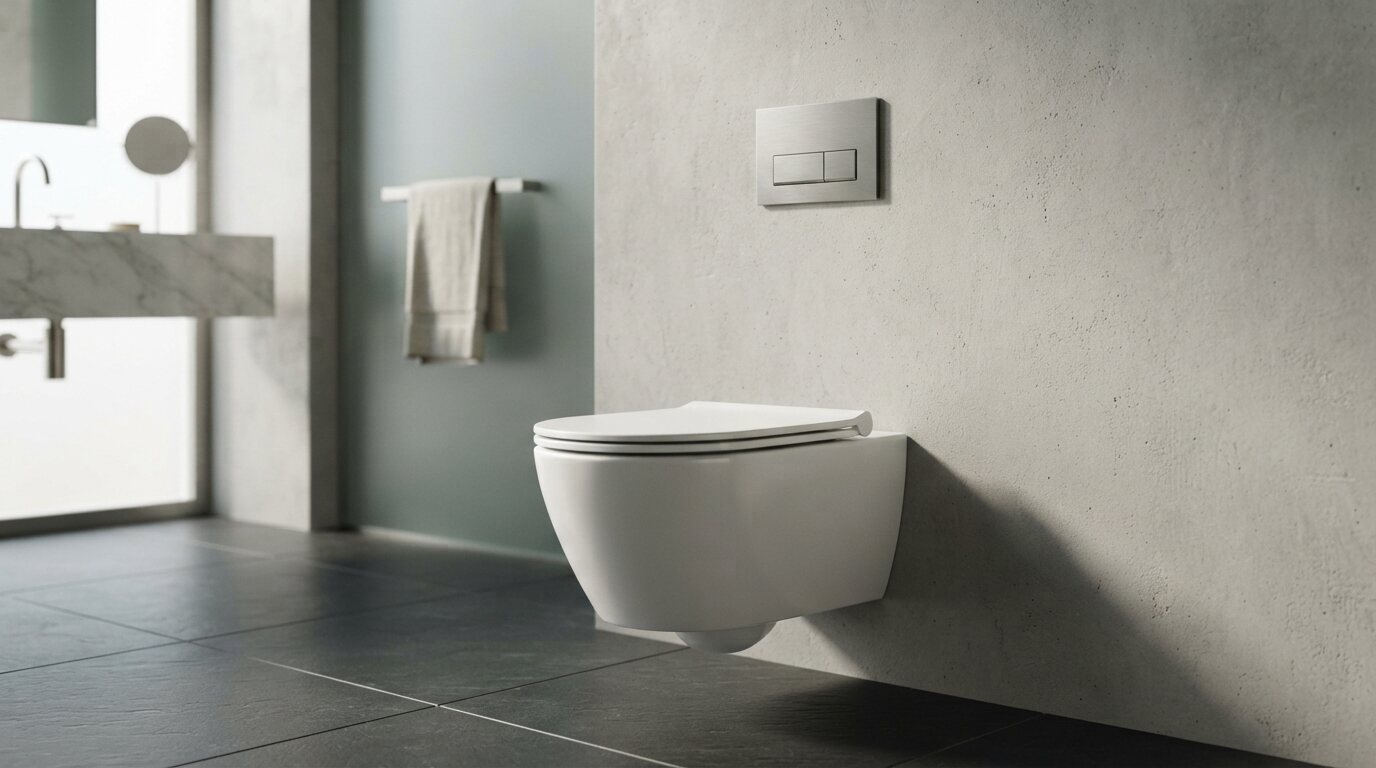
Wall-hung toilets are a popular choice for modern bathrooms, offering a sleek, minimalist look and making floor cleaning much easier. However, unlike a standard close-coupled toilet, a wall-hung system involves several interconnected components that must be specified correctly: the toilet pan, the concealed cistern, the support frame, and the flush plate.
Sourcing a complete wall hung toilet China system requires careful attention to detail to ensure compatibility and proper installation. In this guide, we will walk you through each component and what you need to specify when purchasing from Chinese factories.
Understanding the Components of a Wall-Hung Toilet System
A complete wall-hung toilet system consists of four main parts, each playing a critical role in function and aesthetics:
- The Toilet Pan: The visible ceramic bowl, available in various designs.
- The Concealed Cistern: The water tank hidden within the wall, responsible for flushing.
- The Support Frame: A robust steel frame that holds the cistern and supports the toilet pan’s weight.
- The Flush Plate: The visible buttons on the wall that activate the flush mechanism.
It’s important to understand that while some factories offer complete sets, it’s common for these components to come from different specialized manufacturers. For example, a ceramic factory makes the pan, while another factory makes the frame and cistern.
The Wall-Hung Toilet Pan: Design and Material Considerations
The toilet pan is the most visible part of your wall-hung toilet. When specifying, focus on these aspects:
- Material: Almost all toilet pans are made from vitreous china (ceramic). The quality of the glazing is crucial for hygiene and durability. Look for a smooth, even, non-porous finish that resists stains and is easy to clean.
- Design:
- Rimless vs. Rimmed: Rimless designs are increasingly popular as they eliminate the traditional rim where germs can hide, leading to a more hygienic and easier-to-clean bowl. Rimmed designs are generally more affordable.
- Shape: Common shapes include round, D-shaped, and square. This is largely an aesthetic choice to match your bathroom design.
- Dimensions:
- Projection: The distance the toilet extends from the wall. Typical projections range from 500mm to 600mm. Consider your bathroom space.
- Width: Typically between 350mm and 400mm.
- Mounting Holes: The standard center-to-center distance for the mounting bolts on the toilet pan is 180mm. This is a critical dimension for compatibility with the support frame.
- Finish/Color: While glossy white is standard, you can find matte white, matte black, or other custom colors. Be aware that non-standard colors typically have higher MOQs (Minimum Order Quantities) and higher prices, sometimes 2-3 times more than standard white.
Typical Price Range: For a standard white vitreous china wall-hung pan, expect to pay USD 30-80 from a factory. Rimless designs or special finishes can range from USD 80-150+.
MOQ: Factories typically require an MOQ of 50-100 units for toilet pans, depending on the design and factory size.
Concealed Cisterns and Support Frames for Your Wall Hung Toilet China Project
The concealed cistern and support frame are the backbone of any wall hung toilet China system. They are hidden behind the wall, so their quality and specifications are paramount for long-term reliability and ease of installation.
The Support Frame: Stability and Installation
- Frame Types:
- Floor-Mounted (Self-Supporting): Most common. These frames have feet that extend to the floor, taking the weight. Ideal for stud walls (plasterboard, timber, metal) where the wall itself cannot bear the full load.
- Wall-Mounted: Designed to be fixed directly to a solid brick or concrete wall. Less common for residential projects unless the wall is very robust.
- Corner Frames: For corner installations, though less common.
- Height:
- Standard Height (1120-1180mm): Most common, suitable for full-height walls.
- Low Height (820-980mm): Designed for installation under windows or within half-height partition walls.
- Width: Typically 400mm to 500mm. Ensure you have enough space within your wall cavity.
- Load Capacity: A good quality frame should be tested to support at least 400kg. This ensures it can safely hold the toilet pan and user weight.
- Material: Usually powder-coated steel for corrosion resistance.
- Adjustability: Look for frames with adjustable feet and pan mounting bolts to allow for precise leveling and height setting.
The Concealed Cistern: Flushing Mechanism and Water Saving
- Material: High-density polyethylene (HDPE) is standard for the cistern tank itself.
- Flush Volume: Most modern cisterns offer dual-flush mechanisms to save water. Common volumes are 3/6 liters (half/full flush), 2.5/5 liters, or 2/4 liters. Confirm these volumes meet your local water efficiency standards.
- Internal Valves: This is arguably the most critical component for longevity. The fill valve (which refills the cistern) and the flush valve (which releases water) are prone to wear. We strongly recommend specifying cisterns with high-quality internal components, ideally from reputable brands like WDI (a major Chinese manufacturer of cistern internals) or international brands like Fluidmaster. Generic internals can fail quickly, leading to leaks and costly repairs.
- Access: Cisterns are designed for front access (through the flush plate opening) for maintenance. Ensure the design allows easy removal and replacement of internal parts.
- Insulation: Anti-condensation insulation around the cistern prevents water droplets from forming on the outside of the tank, which could damage the wall structure.
- Water Inlet: Typically a G1/2″ connection for cold water supply.
- Waste Outlet: The frame typically accommodates both horizontal (P-trap) and vertical (S-trap) waste connections, usually Ø90mm or Ø100mm.
Common Mistake: Not matching the frame type to the wall construction. A floor-mounted frame is essential for stud walls, while a wall-mounted frame is only suitable for very strong solid walls.
Typical Price Range: A quality frame and cistern combination, especially with branded internals, can range from USD 70-150 from Chinese factories.
Flush Plates: The Visible Interface
The flush plate is the only part of the cistern system that remains visible, acting as both the functional interface and a design element.
- Compatibility is Key: This is the most important factor. Flush plates are specific to the cistern brand and often to particular cistern models. You cannot mix and match flush plates and cisterns from different manufacturers unless explicitly stated by the manufacturer. Always confirm compatibility when ordering.
- Material:
- ABS Plastic: Most common and affordable.
- Glass: Offers a sleek, modern look.
- Stainless Steel/Brass: Premium options, more durable and resistant to wear.
- Finish: Chrome is standard, but you can find matte black, brushed gold, white, and other custom finishes to match your tapware and bathroom accessories.
- Design: Various button shapes (round, square) and plate designs are available.
- Actuation: Most are mechanical (push-button), which is reliable and simple. Pneumatic (air-driven) and electronic options exist but are less common for residential use.
Typical Price Range: ABS plastic flush plates are USD 10-50. Glass or metal plates can range from USD 40-100+.
Installation Considerations and Rough-in Dimensions
Proper installation planning is crucial for wall-hung toilets. These are the key dimensions and considerations:
- Finished Floor Level (FFL): All measurements for toilet height are typically taken from the FFL.
- Toilet Height: The top of the toilet pan is typically installed 400-450mm from the FFL for ergonomic comfort. Adjustable frames allow for precise setting.
- Wall Type: As discussed, this dictates the frame choice. Ensure your installer understands whether it’s a solid wall or a stud wall.
- Wall Thickness: Account for the frame depth (typically 120-180mm) plus the thickness of the plasterboard/tiles.
Typical Rough-in Dimensions Table
| Component | Typical Dimension / Specification | Notes |
|---|---|---|
| Pan Mounting Bolts | 180mm center-to-center | Standard for most wall-hung pans |
| Frame Height | 820mm (low) / 1120mm (standard) | Choose based on wall height/window position |
| Frame Width | 400-500mm | Needs adequate space within wall cavity |
| Waste Outlet Pipe | Ø90mm or Ø100mm | Connects to main drainage system |
| Water Inlet Pipe | G1/2″ | Standard cold water connection |
| Finished Pan Height | 400-450mm from FFL | Ergonomic height for most users |
| Pan Projection | 500-600mm | Consider bathroom space and traffic flow |
Brands and Sourcing from China
China is a major manufacturing hub for sanitary ware. In Foshan, you’ll find numerous factories producing wall-hung toilets, frames, and cisterns. Some well-known Chinese brands that produce quality sanitary ware include WDI (specializing in cisterns and internals), Bolina, Huida, Jomoo, and Monalisa. Many smaller factories also produce excellent OEM/ODM products for international brands.
When sourcing, focus on factories with a good reputation for quality control. Important checks include the smoothness and consistency of ceramic glazing, the welding quality of the steel frame, the load-bearing test results for the frame, and the reliability of the cistern’s internal components. Always ask for certifications relevant to your market, such as CE for Europe, Watermark for Australia, or WRAS for the UK, if required. You can find a wide range of options in our sanitary ware catalog.
Visiting the factories and showrooms in Foshan is highly recommended if your project volume justifies it. This allows you to inspect product quality firsthand and discuss specifications directly. Learn more about visiting Foshan and exploring the building materials markets.
What to Confirm Before Ordering: A Checklist
- Toilet Pan: Design (rimless/rimmed), dimensions (projection, width), color, glazing quality.
- Cistern: Flush volume (e.g., 3/6L), brand/quality of internal valves (critical!), anti-condensation insulation.
- Support Frame: Type (floor-mounted/wall-mounted), height (standard/low), load capacity, material (powder-coated steel).
- Flush Plate: Design, material, finish, and most importantly, **guaranteed compatibility** with the chosen cistern.
- Rough-in Dimensions: Confirm pan bolt spacing (180mm standard), waste pipe size (Ø90/100mm), and water inlet (G1/2″).
- Wall Construction: Inform the supplier if it’s for a solid wall or a stud wall installation.
- Certifications: Verify that products meet any required international standards for your market (e.g., CE, Watermark, WRAS).
- Packaging: Ensure robust packaging suitable for international shipping to prevent damage.
Specifying wall-hung toilets and concealed cisterns can be complex, especially when coordinating multiple components from different suppliers. We help buyers navigate these challenges by identifying reliable factories, verifying product specifications, conducting quality control checks, and consolidating shipments. Our goal is to ensure you receive a complete and compatible system for your project. Learn more about how our sourcing agent service can assist you.
By carefully specifying each component and understanding the critical dimensions, you can ensure a successful installation and a functional, aesthetically pleasing wall-hung toilet system. Thorough planning and quality checks are key to avoiding costly issues down the line.
Planning to buy building materials in Foshan?
Tell us what you need and when you plan to come. We reply the same day with a realistic plan, price ranges and which markets to visit.