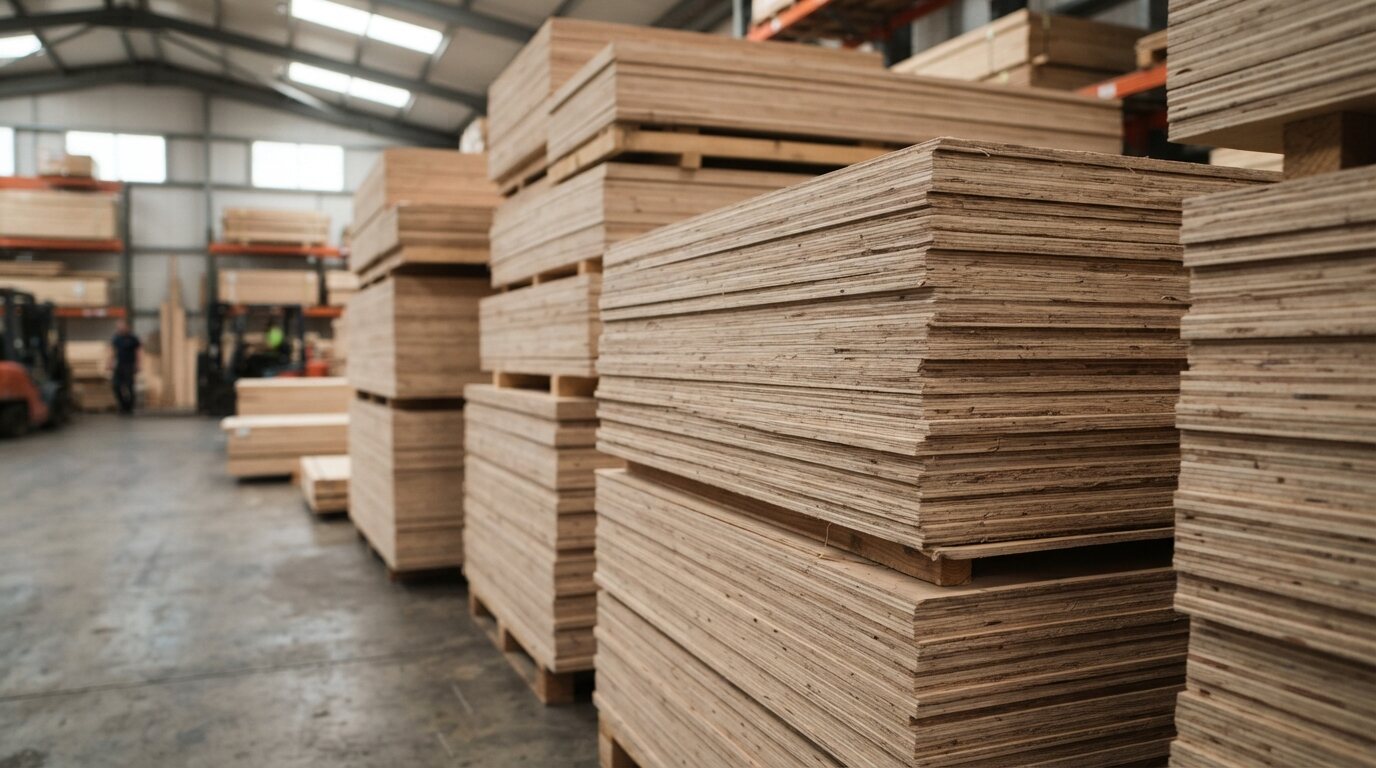
Linyi, a city in Shandong Province, China, has cemented its reputation as the country’s undisputed capital for wood-based panels. For construction buyers worldwide, the Linyi plywood market and its surrounding industrial clusters offer an immense variety of products, competitive pricing, and a well-established supply chain for everything from structural panels to decorative boards. Whether you are a villa owner building a new home, a developer managing a large-scale project, or an importer stocking your warehouse, Linyi is a critical sourcing destination.
We regularly visit Linyi to inspect factories and source various panel products for our clients. The sheer scale of production, combined with efficient logistics to major ports like Qingdao, makes it an attractive option for international procurement. However, navigating the vast array of suppliers and product specifications requires careful attention to detail to ensure you receive the quality and performance your projects demand.
Linyi: China’s Wood-Based Panel Production Powerhouse
Linyi’s dominance in the wood-based panel industry stems from several factors. Historically, the region has abundant timber resources, particularly fast-growing poplar trees, which serve as a primary raw material for many products. Over decades, this led to the development of a dense network of factories, from small workshops to large-scale automated plants. This concentration fosters intense competition, driving down prices and encouraging innovation. The local government has also supported the industry, creating a robust ecosystem that includes raw material suppliers, machinery manufacturers, glue producers, and a skilled labor force. This makes Linyi a one-stop shop for sourcing a wide range of plywood, OSB, MDF, and other engineered wood products.
Film-Faced Plywood: The Foundation for Concrete Formwork
Film-faced plywood is one of the most sought-after products from Linyi, primarily used as concrete formwork in construction due to its smooth, durable surface and reusability. When sourcing this product, several factors are critical:
- Core Material: The most common cores are poplar, eucalyptus, or a mixed hardwood combination. Poplar is generally lighter and more economical, while eucalyptus and hardwood cores offer higher density and strength, often leading to more reuses.
- Thicknesses: Standard thicknesses range from 9mm to 21mm, with 12mm, 15mm, and 18mm being the most common for formwork.
- Film Quality: The film can be black, brown, or red, with phenolic resin films offering superior wear resistance and water impermeability compared to cheaper melamine films. A good quality phenolic film can withstand more pours.
- Glue Type: For exterior and formwork applications, you need WBP (Water Boiled Proof) glue. There are different grades of WBP, with phenolic resin glue offering the best water resistance and bonding strength, essential for multiple reuses and outdoor exposure. Melamine WBP is a more economical option but offers less durability.
- Number of Reuses: This is a key metric. High-quality film-faced plywood with a dense core and phenolic WBP glue can typically be reused 8-15 times, sometimes more, reducing overall project costs. Cheaper alternatives might only last 3-5 reuses.
Typical prices for 18mm film-faced plywood with a poplar core and good quality WBP glue can range from $280 to $400 USD per cubic meter (FOB Qingdao), depending on the specific core, film, and glue quality. MOQs are usually one 20GP container (approximately 21-23 cubic meters).
OSB (Oriented Strand Board): Structural Strength and Versatility
OSB is an engineered wood panel made by compressing layers of wood strands with adhesives. It’s widely used for structural applications such as wall sheathing, subflooring, and roof decking. Linyi produces a significant volume of OSB, primarily OSB/3, which is suitable for load-bearing applications in humid conditions.
- Types: While OSB/2 is for interior, dry conditions, OSB/3 is the standard for general construction due to its moisture resistance. OSB/4 is for heavy-duty load-bearing applications in humid conditions, but less common for typical imports.
- Thicknesses: Common thicknesses range from 6mm for light sheathing to 25mm for heavy-duty subflooring. 9mm, 12mm, 15mm, and 18mm are frequently ordered.
- Glue Types: Most OSB from Linyi uses MDI (methylene diphenyl diisocyanate) or PMDI (polymeric MDI) glues, which offer excellent bonding strength and moisture resistance, often with lower formaldehyde emissions than traditional urea-formaldehyde glues.
- Moisture Resistance: Ensure the OSB meets the appropriate standard for your climate. OSB/3 is designed to withstand temporary exposure to moisture.
Prices for OSB/3, 12mm thick, typically range from $250 to $350 USD per cubic meter (FOB Qingdao), depending on wood species, glue, and specific quality. MOQs are similar to plywood, usually one 20GP container.
MDF (Medium Density Fiberboard): Smooth Finish and Machinability
MDF is a versatile engineered wood product made from wood fibers, wax, and a resin binder, pressed into panels. It’s prized for its smooth surface, uniform density, and excellent machinability, making it ideal for furniture, cabinetry, and interior decorative applications. Many of our clients source MDF from Linyi for their kitchen and bathroom cabinets projects.
- Types: Plain MDF is the base product. Melamine laminated MDF comes with a decorative paper layer for aesthetics. Moisture-resistant (MR) MDF is treated for use in humid environments like bathrooms.
- Thicknesses: Available in a wide range, from thin 2.5mm boards for back panels to thick 30mm boards for robust furniture components. Common thicknesses include 6mm, 9mm, 12mm, 15mm, 18mm, and 25mm.
- Density: Higher density MDF offers better screw-holding and strength, important for furniture. Standard density is typically 680-750 kg/m³.
- Glue Types: Urea-Formaldehyde (UF) is common for standard MDF. For low formaldehyde emission, suppliers offer E1 or E0 grade MDF. Melamine-Urea-Formaldehyde (MUF) glue is used for moisture-resistant MDF.
Standard plain MDF (E2 grade) in 18mm thickness can range from $180 to $280 USD per cubic meter (FOB Qingdao). For E1 or MR grades, expect higher prices. MOQs are generally one 20GP container.
Grades, Glue Types, and Moisture Content: Key Quality Factors
Understanding these technical specifications is crucial for successful sourcing:
Plywood Grades
Plywood grades typically refer to the quality of the face and back veneers. Common grades are A/B, B/C, C/D. A-grade veneers are smooth and free of defects, while D-grade can have knots and patches. For structural applications like formwork, the internal core quality and glue are more important than the face veneer grade, though a good face helps with concrete finish.
Glue Types and Formaldehyde Emission
The glue used significantly impacts performance and health safety. As discussed, WBP phenolic glues are for exterior/wet use, while MR urea-formaldehyde glues are for interior/dry use. Formaldehyde emission standards are critical, especially for interior products like MDF and interior plywood:
- E2: Highest formaldehyde emission, generally not suitable for residential use in many countries.
- E1: Lower emission, widely accepted for interior use.
- E0: Lowest emission, often specified for sensitive environments or strict regulations.
Always specify your required formaldehyde emission standard to the supplier.
Moisture Content (MC)
Proper moisture content is vital for the stability and longevity of wood-based panels. If the MC is too high, panels can warp, swell, or develop mold during transit or storage. If too low, they can absorb moisture and swell. Typically, an MC of 8-12% is considered ideal for most panel products. Factories should have proper drying processes and quality control to ensure consistent MC. We always recommend checking this during pre-shipment inspection.
Logistics: Shipping from Linyi via Qingdao Port
Linyi’s strategic location in Shandong Province provides relatively convenient access to the major international port of Qingdao. This is the primary shipping gateway for most wood-based panels exported from Linyi. The trucking distance from Linyi to Qingdao port is typically around 300-400 kilometers, which translates to a transit time of 1-2 days for road transport.
When ordering, ensure your supplier provides clear FOB (Free On Board) Qingdao pricing. This means the supplier covers the cost of transporting the goods to the port and loading them onto the vessel. Proper packaging is essential for international shipping; panels should be securely bundled with steel straps, protected with edge protectors, and often wrapped in plastic to prevent moisture damage. We also advise checking that the dimensions of the panels are suitable for efficient container loading (20GP or 40HC) to maximize volume and minimize shipping costs. For more details on the shipping process, you can refer to our guide on shipping from China.
What to Confirm Before Ordering from the Linyi Plywood Market
To avoid costly mistakes and ensure you get the right products, always confirm the following with your supplier:
- Product Type: Clearly specify plywood, OSB, or MDF.
- Specific Dimensions: Exact thickness (e.g., 18mm), length, and width (e.g., 1220x2440mm or 4’x8′).
- Core Material (for Plywood): Poplar, eucalyptus, mixed hardwood, or birch.
- Glue Type: WBP (phenolic or melamine), MR, MDI, UF.
- Formaldehyde Emission Standard: E0, E1, or E2.
- Grade/Quality Standard: For plywood, face/back veneer grade; for film-faced, film type and reuses; for MDF/OSB, density and surface finish.
- Moisture Content Range: Typically 8-12%.
- Quantity: Confirm MOQ and total cubic meters/sheets.
- Packaging Requirements: Details on bundling, edge protection, and wrapping.
- Delivery Terms: Clearly state FOB Qingdao or other Incoterms.
- Lead Time: Typical production time after deposit (often 15-30 days).
- Certifications: If specific certifications (e.g., CARB, FSC) are required for your market.
Sourcing wood-based panels from Linyi can be highly beneficial, but the sheer volume of suppliers and variations in quality make independent sourcing challenging. We provide on-the-ground support, performing factory audits, quality inspections, and managing the entire procurement process from specification to shipping. Our sourcing agent service ensures your order meets your exact requirements and quality standards.
By understanding the key products and quality factors, you can make informed decisions when sourcing from the Linyi plywood market. With careful planning and robust quality control, Linyi offers a world of opportunities for your construction material needs.
Planning to buy building materials in Foshan?
Tell us what you need and when you plan to come. We reply the same day with a realistic plan, price ranges and which markets to visit.