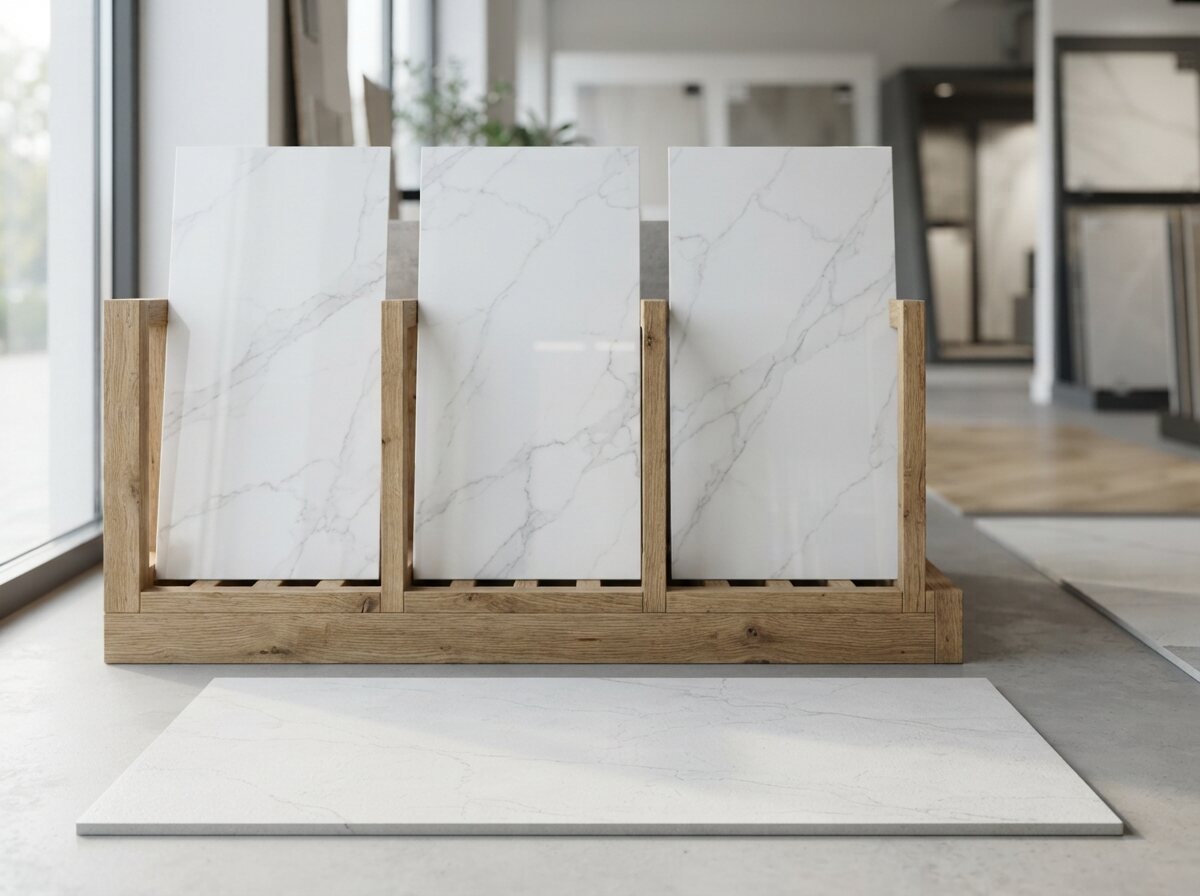
Tiles are the product most people think of when they think of Foshan, and for good reason: the kilns around the city produce more porcelain than any other region in the world. They are also the product where first-time buyers make the most avoidable mistakes. This guide walks through an order the way we run it for clients, then covers what a typical order looks like, how long it takes, what it costs, and where things go wrong.
1. Decide formats before you look at designs
The format drives waste, labour cost and price. 600×1200 and 800×800 are the workhorses; 600×600 is cheaper per m² but slower to lay; 1200×2400 slabs look spectacular and need skilled installers. Fix the format per room first, then choose designs within it. A rough rule: order 5% extra for straight lay, 8–10% for diagonal or pattern lays.
2. Understand what you are being shown
Showrooms in China Ceramics City display the brands’ best product, priced for the domestic retail market. The factory that made it may sell the identical tile under three other names. Note the model number and the back-stamp; that is how we trace the kiln. And ask which grade you are looking at – first choice (the top grade) is what you want for living areas. If the grading terms are new to you, we have a short piece on how Chinese tile grades work.
3. Get prices at factory level
Factory pricing and showroom pricing are set differently. Ask for the ex-works price against a written specification so you are comparing like with like. For a villa-size order (800–1,500 m²) you will not be a big customer, so the way to get good pricing is to buy from stock designs and to consolidate with other buyers’ containers – which is what an agent does.
4. Sample, then seal the sample
Get a full tile, not a chip. Check it in daylight and under your intended lighting. When you order, that tile is signed, sealed and kept as the reference for shade and finish; the pro-forma states the shade and calibre batch numbers.
5. Write the specification
Size, thickness, finish, rectified or not, grade, water absorption, quantity in m² and in boxes, packing (pallets, corner boards), and the delivery date. All in Chinese on the pro-forma, with photos of the reference tile attached.
6. Inspect before you pay the balance
At the factory or warehouse: count pallets, open random cartons from different pallets, check shade against the reference, measure a few tiles, look for chipped edges and glaze defects. Photograph everything. Only then release the 70%.
7. Ship it properly
Palletised, strapped, corner-protected, film-wrapped, and loaded with heavy pallets low and level. A 20ft container carries roughly 1,000 m² of 800×800; a 40ft is limited by road weight in most countries. Details in our shipping guide.
What a typical villa order looks like
A four-bedroom villa with about 1,200 m² of floor and 300 m² of tiled wall, numbers rounded:
| Area | Tile | Net m² | Ordered m² | Boxes |
|---|---|---|---|---|
| Living, dining, bedrooms | 800×800 polished glazed porcelain, rectified | 700 | 735 (5% extra) | 383 boxes of 3 pcs (1.92 m²) |
| Kitchen and bathroom floors | 600×600 matt porcelain | 200 | 216 (8% extra, many cuts) | 150 boxes of 4 pcs (1.44 m²) |
| Bathroom walls | 300×600 glazed ceramic | 300 | 324 (8% extra) | 225 boxes of 8 pcs (1.44 m²) |
| Terrace and pool surround | 600×600 R11 anti-slip porcelain | 300 | 315 (5% extra) | 219 boxes of 4 pcs (1.44 m²) |
That is about 1,590 m². Porcelain at 9–10 mm weighs roughly 21–24 kg per m² and glazed ceramic wall tile 13–16 kg, so the order comes to about 33 tonnes. That exceeds the payload of a 20ft, and in most destination countries a 40ft cannot legally be trucked at that weight either. In practice it ships as one 40ft loaded to the local road limit (typically 24–27 tonnes) with the balance in a shared container. Working that out before the deposit is paid is part of the job.
On price, stock designs from mid-sized Foshan kilns currently sit in these ex-works ranges, depending on design and quantity: 800×800 polished glazed porcelain RMB 38–65 per m²; 600×600 matt porcelain RMB 30–50; 300×600 glazed ceramic wall tile RMB 22–40; R11 anti-slip porcelain RMB 35–55. A blended RMB 40–50 per m² is a fair planning figure, so around RMB 65,000–80,000 for the goods before pallets, inland transport, export handling and sea freight. Big-brand showroom prices can be two to four times that. The add-on costs are broken down in our note on what a container of building materials really costs.
How long it takes
- Selection and sampling: two to three days on the ground, or one to two weeks by email and courier.
- Stock designs: picking, palletising and packing take 3–10 days after the deposit.
- Production orders: 20–35 days for a design already in the kiln’s rotation, 35–50 days for anything custom. Minimum runs for a bespoke design are usually 1,000–3,000 m² per colour.
- Inspection, booking and loading: about a week from goods ready to container gate-in.
- Sea freight: 12–20 days to Southeast Asia and the Gulf, 20–30 days to East Africa and the Mediterranean, 30–45 days to West Africa, Latin America and the Caribbean.
So a stock order takes roughly six to nine weeks from deposit to arrival port, and a production order ten to fourteen. Chinese New Year adds three to five weeks to anything not already loaded, because the kilns shut down; the first week of October is a shorter break. If your installers are booked, work backwards with these figures and add a fortnight.
What we do at each step
Before the trip we turn your drawings into a room-by-room quantity list. On the ground we take you to the markets and to two or three kilns whose stock suits the budget, and trace model numbers and back-stamps to the actual maker; our buying trips page explains how a visit runs. We negotiate ex-works prices against the written spec, combine small quantities with other clients’ orders where possible, draft the pro-forma in Chinese, hold the sealed reference tiles, inspect before the balance is released, supervise loading and pass the documents to your forwarder.
Foshan, Zibo or Jinjiang?
Foshan is the right default for most foreign buyers: the widest range, the deepest stock in large formats and slabs, and tiles, sanitary ware, doors and lighting on the same trip. It is not always the cheapest. Zibo in Shandong makes competent 600×600, 800×800 and 600×1200 porcelain at 10–20% below comparable Foshan product and ships from Qingdao, which suits Northeast Asia and Russia. Jinjiang in Fujian is strongest in exterior wall tiles and lower-priced glazed ceramic, shipping from Xiamen. For one mixed container the saving rarely covers the extra travel and loss of choice; for repeat loads of one or two formats it can. We cover the trade-offs in our note on the tile clusters outside Foshan.
Common mistakes
- Pricing from the showroom. That is a domestic retail price with the brand’s margin built in. Ask for ex-works against a spec.
- Under-ordering the extra. Topping up later means a different firing batch and, usually, a visible shade change. The 5–10% extra is cheaper than a second shipment.
- Leaving “rectified” and the grade off the spec. If it is not written in Chinese, the factory is entitled to supply the non-rectified or second-grade equivalent.
- Ignoring road weight at destination. A container legal to load in China may be illegal to truck at home. Check axle limits first.
A note on prices: every figure in this guide is an indicative estimate from recent orders. Factory prices, freight rates and exchange rates move, so treat them as a planning guide and ask us for a current quote before you budget.
Frequently asked questions
What is the minimum order if I only need tiles for one house?
For stock designs there is no meaningful minimum beyond full pallets. A kiln will happily sell 300 m² of a design it has on the floor; what it will not do is run a special firing for less than about 1,000 m² per colour. For very small quantities the real constraint is freight, and a shared container is the answer.
Can I mix tiles from several factories in one container?
Yes, and most villa orders do. Each factory palletises its own goods and trucks them to a consolidation warehouse, where the container is stuffed. It adds a few hundred RMB per pallet and a couple of days, and gives you one bill of lading. The range of tile types and formats we source is on the catalogue page.
How do I know the factory will ship the same tile as the sample?
The sealed reference tile and the shade and calibre numbers on the pro-forma are the contractual protection; the inspection before the balance is the practical one. We open cartons from several pallets and lay tiles from each beside the reference in daylight. If the shade is off, the goods do not leave and the balance is not paid.
Is it worth buying big-brand tiles in Foshan?
Sometimes. The large brands have the most consistent quality control and the widest design libraries, and for a high-end project the premium can be justified. For most residential work the same kilns supply near-identical product under other names at a fraction of the price.
Do I need to come to China, or can you do it by email?
We handle plenty of orders remotely with samples couriered to you, and for repeat buyers that works well. For a first whole-house order we recommend coming: choosing designs from photographs is unreliable, and three days on the ground lets you see the tile in daylight and settle the specification with the factory in the room.
Planning to buy building materials in Foshan?
Tell us what you need and when you plan to come. We aim to reply the same business day with a realistic plan, price ranges and which markets to visit.