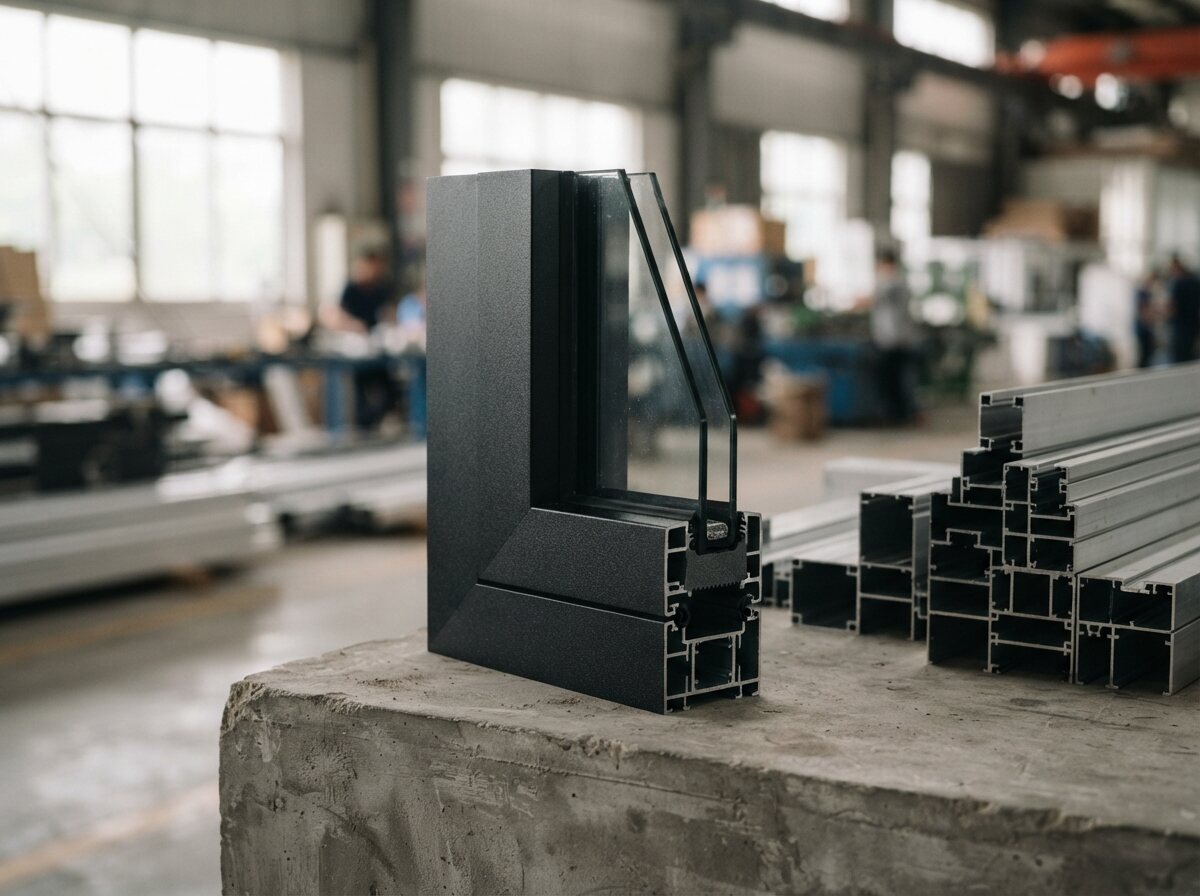
Windows are the most technical thing most buyers put in a container, and the item where a vague specification costs the most. A window that arrives 15 mm too wide, with the handle on the wrong side, cannot be fixed on site. This is the checklist we run through with every factory in Dali before a client pays a deposit.
The 12-point checklist
- System and series – the factory’s system name and frame depth (e.g. 65-series casement, 120-series lift-and-slide). Different series are not interchangeable.
- Alloy and temper – 6063-T5 or T6.
- Wall thickness – ≥1.4 mm windows, ≥2.0 mm doors; 1.8–2.2 mm for large panes or high wind.
- Thermal break – PA66 GF25 polyamide strip; width stated. Not PVC.
- Glass build-up – e.g. 6 Low-E + 12A argon + 6 tempered; laminated where safety codes require.
- Hardware brand per function – hinges/friction stays, handles, locks, rollers. Locking points per sash.
- Gaskets and seals – EPDM, three seals on casement, brush + EPDM on sliding.
- Finish – powder coat RAL number, thickness (≥60 µm), salt-spray hours; PVDF or anodising for coastal sites.
- Shop drawings – every opening with size, opening direction, handle side and height, sill detail. Signed by you.
- Performance – air, water and wind test reports for the system (ask for them; large factories have them).
- Packing – frames in foam and film on A-frames or in crates; glass separate for large units; ISPM-15 timber.
- Installation pack – anchors, sealant recommendation, installation manual in English; supervisor available for large projects.
Price ranges and system descriptions are in the doors & windows guide. The rest of this page explains why each point is on the list, what it does to the price, and how a real order runs from showroom to site.
Why each point matters
System and series. A window factory extrudes or buys a named profile system and assembles it. The series number is the frame depth in millimetres, and a 65-series and a 75-series casement from the same factory use different dies, gaskets and hardware grooves. A quote on one and a sample of another are two different products.
Alloy, temper and wall thickness. 6063 is the standard architectural alloy. Wall thickness is where cheap quotes hide: a 1.2 mm frame and a 1.6 mm frame look identical in a showroom, but the thinner one saves the factory perhaps 8–12% on metal and will twist on a two-metre sash within a few years. Take callipers on the trip; we do.
Thermal break. PA66 with 25% glass fibre expands at the same rate as aluminium. PVC strips are cheaper, look the same when new, and separate from the frame after a few summers. Ask for the strip width; 14.8 mm and 20 mm are common, and wider insulates better.
Glass. Write the build-up as a formula, not a description. “Double glazed” means nothing; “6 Low-E + 12A argon + 6 tempered” is a specific unit. Tempered panes carry a small corner stamp that can be checked on arrival. If your code needs laminated glass in doors or low-level glazing, say so on the drawings.
Hardware. Hardware is often 15–25% of the finished window price and is where factories quietly substitute. Chinese brands such as Kinlong and HOPO are good and widely used; German brands (Siegenia, Roto, Hoppe) add cost and lead time. What matters is that the brand on the quote is the brand in the box. Three or more locking points per sash is normal on a decent casement.
Gaskets and finish. EPDM stays flexible for decades; cheaper rubber hardens and shrinks. 60 µm powder coat with a stated salt-spray rating (500 hours is common, 1,000 is better) covers most inland sites. Within a few kilometres of the sea we push clients to PVDF or anodising, which adds roughly 10–20% to the frame price and is far cheaper than replacing corroded windows in five years.
Shop drawings. The most important item on the list. Once you sign, anything wrong is your cost. In our experience roughly one order in three has at least one error at the first draft, usually a mirrored handle or an opening direction, so we go through drawings line by line with clients before signing.
Performance reports. These are produced for the system, not for your order, and any factory of reasonable size has them from a Chinese test lab. They are useful for your engineer and sometimes needed for local approval.
What each choice does to the price
Rough effects on the per-square-metre price, which vary by factory and order size:
- Basic non-thermal-break casement to a 65-series thermal-break system: typically +30–50%.
- Clear double glazing to Low-E argon: roughly +8–15% on the finished window.
- Laminated inner pane instead of tempered: +10–20% on the glass component.
- German hardware instead of a good Chinese brand: +15–30%, and often two or three extra weeks while the factory waits for hardware.
- PVDF or anodised finish instead of standard powder coat: +10–20% on frames.
Small windows also cost more per square metre than large ones, because hardware and labour are roughly fixed per unit.
Lead times and how the timeline runs
For made-to-measure windows, 25–45 days from deposit and signed drawings to goods ready is typical. Small orders with standard hardware sit at the short end; imported hardware, PVDF, laminated glass or curved units push to the long end. Allow about a week before that for drawings to go back and forth, then sea freight on top (times by region are on the shipping page). A buyer who confirms in early March should expect windows on site in May or June. Chinese New Year adds three to four weeks to anything ordered in January.
The sequence is: showroom visit, opening schedule to the factory, quotation, deposit (usually 30%), shop drawings, production, our inspection at the factory, balance, loading. We are present at drawings and at inspection, because those are the two points where problems are still cheap to fix.
Packing and installation
Frames should be wrapped in foam and stretch film, then fixed upright on steel or timber A-frames, or crated for smaller units. Glass over about 2 m² usually ships separately in glass crates and is glazed on site. All timber must be ISPM-15 heat-treated and stamped, or the container may be refused or fumigated at destination. We photograph the loading.
The installation pack should include the right anchors for your wall type, a sealant recommendation (normally neutral-cure silicone) and an English manual with the glazing sequence. For a villa, a competent local fitter with the manual is enough. For a block of flats or anything with curtain-wall elements, ask the factory for a supervisor for the first week; the cost is normally flights, accommodation and a daily rate.
A worked example: a four-bedroom villa
A typical villa order looks like this. Around 22 openings: 14 casement windows, four fixed panes, one 3.6 m lift-and-slide door to the terrace, two smaller sliding doors and an entrance door, roughly 65–75 m² of glazing in total. The client chose a 70-series thermal-break casement system, 6 Low-E + 12A + 6 tempered glass, Kinlong hardware, RAL 7016 powder coat, and a laminated inner pane on the large door.
The finished order came in at somewhere between a third and a half of the installed price quoted locally in Europe, Australia or the Gulf, before shipping and duty. It filled a bit under half of a 40 ft high-cube, so the client used the rest for tiles and sanitary ware bought on the same trip. Drawings took nine days, production 32 days, and inspection found one scratched sash, remade before loading. Our page on the cost of a container of building materials shows how the numbers stack up for a full-house order.
Common mistakes
- Measuring openings before walls are finished. Windows are made to the finished opening minus a fitting gap. Measure last, not first.
- Signing drawings without checking handle side and opening direction from inside the room.
- Accepting “same as sample” without a written specification. The showroom sample is usually the factory’s best build.
- Forgetting flyscreens, trickle vents or child locks that are normal at home but not default in China.
A note on prices: every figure in this guide is an indicative estimate from recent orders. Factory prices, freight rates and exchange rates move, so treat them as a planning guide and ask us for a current quote before you budget.
Frequently asked questions
Can I buy windows without coming to Foshan?
Yes, if you have a clear opening schedule and are happy to approve on drawings and photographs; we do this for repeat clients. For a first order of any size we still recommend a buying trip, because two hours in a factory with callipers and a torch tells you more than any catalogue.
What is the minimum order?
There is no meaningful MOQ for made-to-measure windows; a factory will make a single villa. What matters is that the freight is sensible, so we normally suggest combining windows with other materials to fill a container.
Will the windows meet my local building code?
The factory can build to almost any specification but does not know your code. You or your architect specify glass type, safety glazing locations and any thermal or wind values, and we write those into the order. The system test reports help your engineer sign it off.
What about warranty and spares?
Factories typically give a written warranty of a few years on frames and hardware. The useful protection is inspection before loading and a small stock of spares: extra handles, a set of rollers and some gasket length.
How do I pay?
Almost always a 30% deposit by bank transfer to the factory, and the balance after inspection and before loading. We do not hold client money.
Planning to buy building materials in Foshan?
Tell us what you need and when you plan to come. We aim to reply the same business day with a realistic plan, price ranges and which markets to visit.