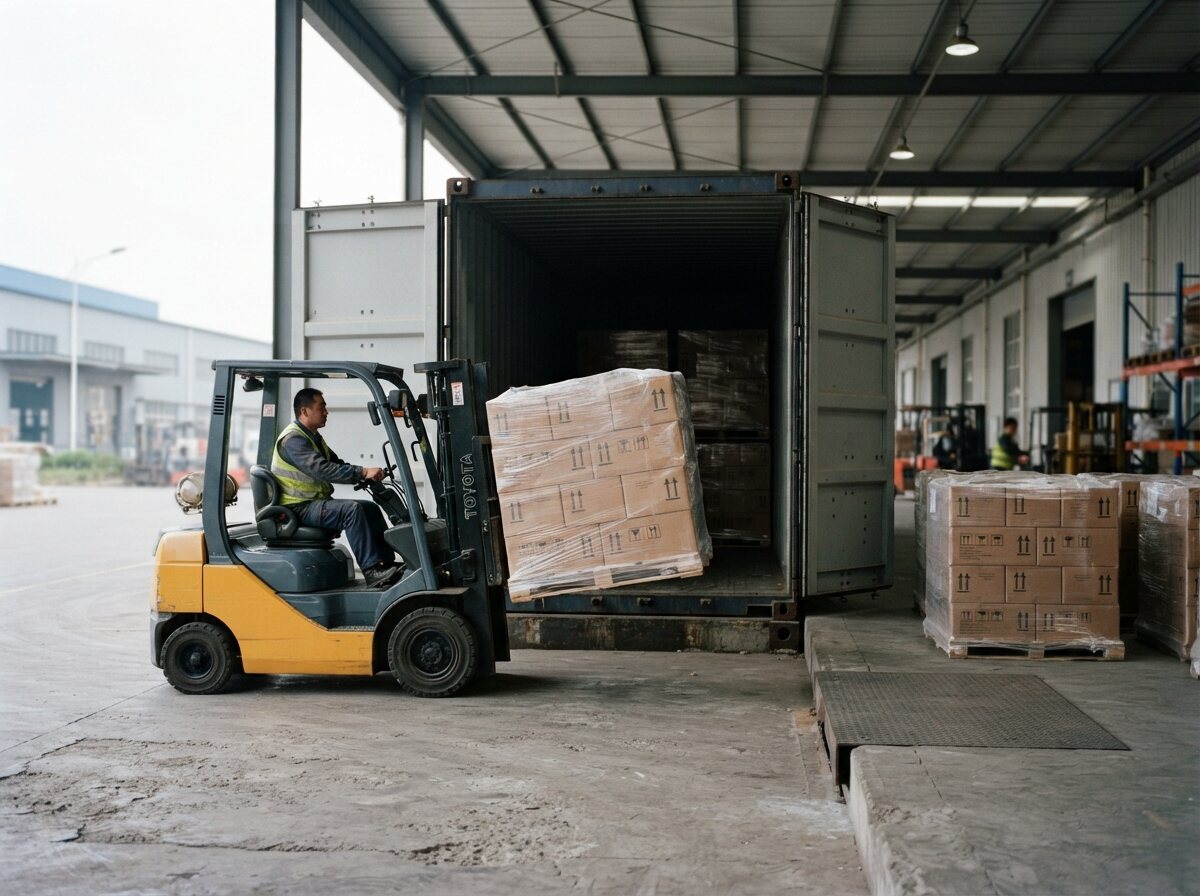
“How much for a container?” is the first question we hear. The honest answer is that it depends on what is inside, but a worked example helps. Below is a typical villa finishing package from recent orders, with rounded numbers.
The goods (FOB Foshan / Shenzhen)
| Category | Quantity | Indicative value |
|---|---|---|
| Porcelain tiles, first choice, 800×800 and 600×1200 | 900 m² | USD 6,500 |
| Bathrooms: 5 WCs, 6 basins, taps, showers, accessories | 5 sets | USD 3,200 |
| Aluminium windows and sliding doors, thermal break, Low-E | 110 m² | USD 14,000 |
| Interior doors, WPC/paint, with hardware | 14 sets | USD 2,800 |
| Kitchen, PET doors, Blum hardware, quartz top | 9 lin. m | USD 5,500 |
| Lighting: downlights, pendants, outdoor | ~180 pcs | USD 2,400 |
| Vanities and wardrobes | 5 + 4 | USD 4,600 |
| Goods total | ≈ USD 39,000 |
How to read the goods table
These are FOB prices: the factory price plus delivery to the port, with export clearance done. They are neither the lowest figures we have seen nor showroom prices; they are what a first-time buyer with a clear specification pays after a normal negotiation on a buying trip.
Two lines dominate. Windows are more than a third of the total, which is typical of any package with thermal-break aluminium and Low-E glass; the same 110 m² in a plain non-thermal profile with single glazing would be closer to USD 7,000. Tiles look cheap by comparison but are the line most sensitive to grade. The USD 6,500 assumes first choice from a mid-range factory at roughly USD 7 per m²; a second choice lot would be nearer USD 4,500, and a premium brand in large-format polished could be USD 12,000 for the same area. See our note on tile grades.
Getting it to your port
| Item | Indicative cost |
|---|---|
| Consolidation, export packing, crates for glass | USD 700 |
| Ocean freight 40ft HC (varies widely by route) | USD 1,800 – 3,500 |
| Origin charges, documents, CO | USD 350 |
| Marine insurance | USD 150 |
| Agent commission (example, 7%) | USD 2,730 |
| CIF-equivalent total | ≈ USD 45,000 – 46,500 |
Freight is the line that moves. From Shenzhen or Nansha, a 40ft HC to Southeast Asia or the Gulf sits at the bottom of the range, Australia and East Africa in the middle, and the east coast of North America, West Africa or South America at the top or beyond it. Rates also swing by season, peaking before Chinese New Year and in late summer. We get a fresh quote when the goods are three weeks from ready, not at the start of the order.
The commission in the example is illustrative. Ours is agreed in advance against order size and scope, and covers factory visits, negotiation, specification, inspection, consolidation and loading, so there is no separate inspection fee.
Does it all fit?
A 40ft high cube holds about 76 m³ and a payload of 26 to 28 tonnes. The package above uses around 55 to 62 m³ once crated and weighs roughly 24 tonnes, of which the tiles alone are about 19. That is the usual shape of a villa order: tiles set the weight, windows and cabinets set the volume, and everything else fits in the gaps.
Weight is the limit to watch. Many countries restrict a loaded 40ft on the road to 24 to 26 tonnes gross, which is why a container of nothing but tiles is loaded to 1,100 to 1,200 m² and no more, with space left over. Past that, the answer is a second 20ft rather than an overloaded 40ft.
20ft, 40ft or LCL
| Option | Capacity | Indicative freight (same route) | Suits |
|---|---|---|---|
| LCL (shared container) | Charged per m³, from 1 m³ | USD 60 – 120 per m³, plus destination handling | Samples, a single bathroom, lighting for one house |
| 20ft | ~28 m³, 20 – 24 t | USD 1,200 – 2,500 | Tiles only, or a small apartment package |
| 40ft HC | ~76 m³, 26 – 28 t | USD 1,800 – 3,500 | A villa, two or three apartments, mixed categories |
LCL is right below about 12 to 15 m³, but destination charges are the trap: the freight looks cheap per cubic metre, then the receiving warehouse adds USD 300 to 600 in handling before you can collect. Above 15 m³, a 20ft is nearly always cheaper per cubic metre and better for fragile goods, because nobody else’s cargo sits on your crates. A 40ft HC costs perhaps 40 percent more than a 20ft for nearly three times the space, so past 25 m³ the larger box is the obvious choice.
At destination
Destination port charges and brokerage: USD 400–900. Duties and VAT depend entirely on your country and the HS codes; tiles, sanitary ware and windows commonly carry 5–15% duty plus local VAT/GST on the CIF value. Budget 15–30% on top of CIF in most markets, less where a free-trade agreement applies.
Two things reduce that figure. First, a Certificate of Origin: ASEAN, Australia, New Zealand, Chile, Peru and several other markets give reduced or zero duty on Chinese-origin goods with the right form. Second, a detailed packing list, so each category is classified under its own HS code rather than the whole container taxed at the highest rate present. Inland haulage from port to site is on top, typically USD 300 to 1,000, and the truck needs somewhere to stand while a forklift or six people unload.
Where the money goes, and when
For a package like this, cash leaves in four stages. Deposits of 30 percent to each factory at the end of the buying trip, about USD 12,000 in total. Balances as each factory finishes production and passes inspection, spread over weeks four to seven. Freight, insurance and our commission around loading, week seven or eight. Duties, VAT and port charges when the container arrives. Nobody needs the full USD 55,000 to 60,000 on day one, but it helps to see the whole shape before the first transfer.
What changes the total
- Windows. A large sliding door, a corner window or a lift-and-slide system moves the total more than any other decision. Our windows and doors pages give ranges by profile and glass.
- Stone. Swapping 200 m² of porcelain for marble slabs adds USD 8,000 to 15,000 and about 3 tonnes.
- Hardware brands. Blum or Hettich hinges and runners on the kitchen add roughly USD 600 to 900 over domestic brands.
- Packing. Glass and stone need timber crates; skipping them saves USD 200 and risks everything.
- Extras. Almost every buyer adds 5 to 10 percent to the list during the trip, so leave room in the container and the budget.
Common budgeting mistakes
The most frequent is comparing an FOB price with a local delivered price; the right comparison is landed cost at your site, duties included, against the local quote. The second is ordering tiles from the floor area without wastage; add 8 to 10 percent for straight lay and 15 percent for diagonal or large formats. The third is treating freight as fixed; it is quoted at booking, not at order. The fourth is forgetting that a container arrives all at once and needs dry, secure storage if the site is not ready.
The comparison
Buyers price the same specification locally before ordering; for this package the local retail quotes we have seen range from USD 75,000 to 120,000 depending on the country. That gap is why the container makes sense even for one house – as long as specification, inspection and packing are done properly.
Put another way, the landed cost of this package is usually USD 55,000 to 60,000 including duty, against USD 75,000 at the low end locally, and the local figure is for whatever the supplier stocks rather than the specification you chose. The saving is earned by doing the specification and inspection work properly, which is the point of buying direct from the factory with someone on the ground rather than from a listing.
A note on prices: every figure in this guide is an indicative estimate from recent orders. Factory prices, freight rates and exchange rates move, so treat them as a planning guide and ask us for a current quote before you budget.
Frequently asked questions
What is the minimum order to make a container worthwhile?
For a 20ft, about USD 10,000 to 12,000 of goods is where freight and fixed charges stop dominating the total. Below that, LCL works for lighting, sanitary ware and small quantities of tiles. A 40ft HC starts to make sense at roughly USD 25,000 of mixed goods.
Can I fill a container with tiles only?
Yes, and it is the most common single-category order. A 20ft carries around 600 to 700 m² of 10 mm porcelain and a 40ft around 1,100 to 1,200 m², both limited by weight. Prices by grade and format are on the tiles pages.
How long from order to delivery?
Windows and kitchens set the pace at five to seven weeks of production. Add one to two weeks for consolidation and booking, then two to six weeks at sea depending on your port. Eleven to fifteen weeks from deposit to your door is realistic for a mixed villa package.
Do I pay duties to you or at my end?
At your end. Your customs broker clears the container and pays duty and VAT on arrival. We provide the commercial invoice, packing list, bill of lading and Certificate of Origin, and can recommend brokers in several countries.
What if I only need half a container?
Ship LCL, or share. We regularly combine two apartment packages from the same developer, or two owners in the same city, into one 40ft and split the freight by volume. Both orders need to be ready within the same fortnight, which we plan for from the start.
Line-by-line ranges are in the catalog; the shipping mechanics are in the shipping guide.
Planning to buy building materials in Foshan?
Tell us what you need and when you plan to come. We aim to reply the same business day with a realistic plan, price ranges and which markets to visit.