There are two practical ways to buy building materials from China: order remotely through an online sourcing platform, or buy in person from the factories with someone representing you on the ground. Both work. They suit different orders, and the choice gets easier once you see what each method actually asks of you.
Knowing who you are dealing with
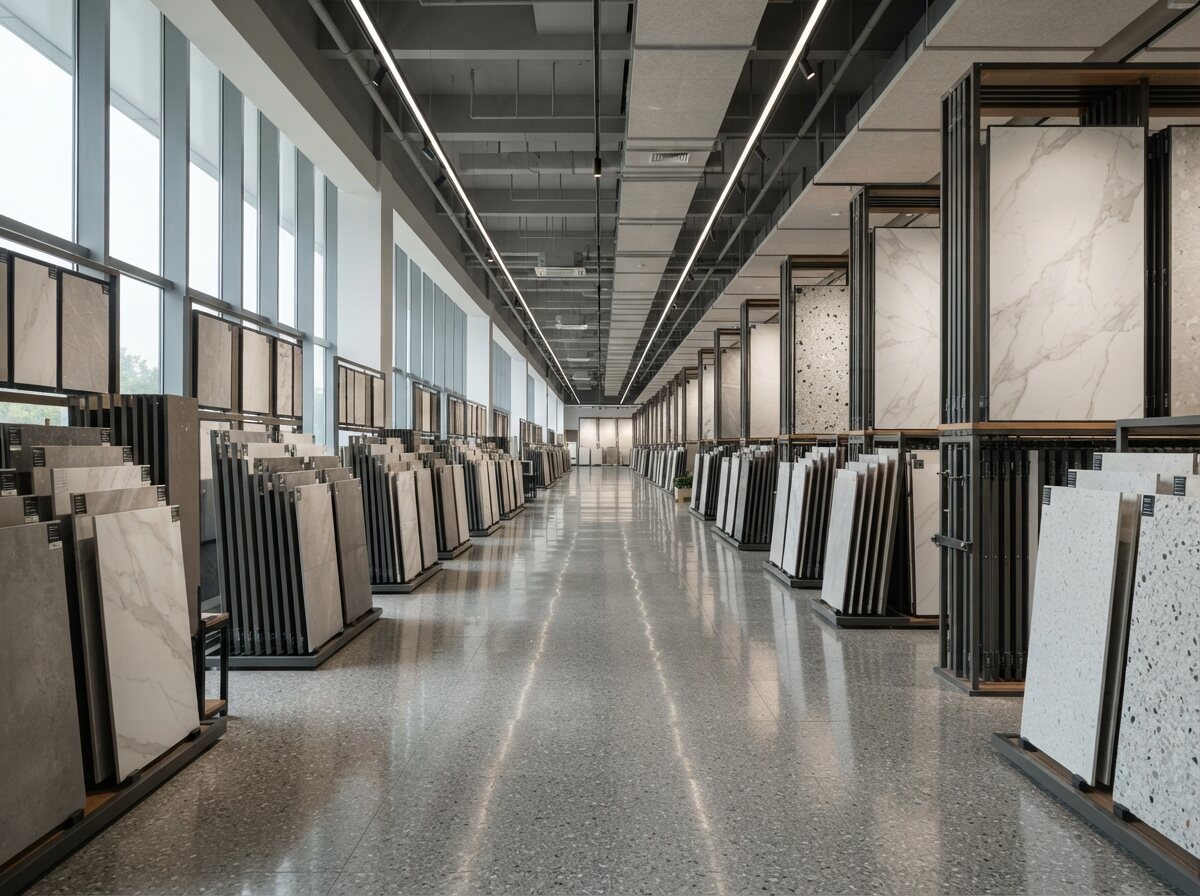
Buying remotely, you form your view of a supplier from listings, photographs and messages. Buying in Foshan, you walk the floor: you see the kiln, the extrusion line or the spray booth, and you know whether the company quoting you is the company making the goods. Our process starts with that visit, and we confirm the business licence and the production capability before you commit to anything.
Most platform listings belong to trading companies rather than factories, and you usually cannot tell which you are talking to. A factory with its own kilns can hold a price and a shade batch across a repeat order; a trader re-quotes from whichever plant has capacity that month, and the second delivery may not match the first.
Agreeing a price
A first quote is an opening position, wherever it comes from. Buying on the ground, the negotiation happens face to face against current factory terms, in Chinese, with someone who buys in this market every week. What that is worth on your particular order depends on the category, the volume and the specification, which is why we quote against your actual list rather than a headline number.
As a rough guide from our own orders, the gap between a platform quote and a factory price agreed in person is usually 10 to 25 percent on tiles and sanitary ware, and wider on made-to-measure items such as aluminium windows or kitchens, where the online figure is often a placeholder revised once real drawings arrive. The saving is not always a lower unit price; sometimes it is a better glaze, a thicker profile or a proper timber crate for the same money.
Settling the specification
Building materials go wrong in the detail: rough-in dimensions, glass build-ups, voltages, tile calibre and shade batch. Written into a chat thread and translated twice, those details are easy to lose. Settled in person, with an interpreter who knows the vocabulary, they are agreed in an afternoon and written into the order in Chinese.
The details that cause the most trouble on remote orders are consistently the same: WC rough-in and trap type; whether a tile price is for first choice or a lower grade; window profile series, wall thickness, glass make-up and opening direction; lighting voltage, driver and colour temperature; kitchen carcass material and hinge brand. None of these is hard to agree. They are simply hard to agree by message.
Checking the goods
Buying remotely puts distance between you and production, so inspection becomes a separate arrangement you have to organise and pay for. We are twenty minutes from most of these factories. Following production and inspecting before loading is part of what we do, not another visit to book.
A third-party inspection typically costs USD 250 to 400 per man-day plus travel, and an inspector can only check the goods against what is written in the contract. If the specification was vague, the report confirms that vague goods were made correctly. Inspecting during production, rather than once at the end, also catches problems while they are still cheap to fix.
Bringing one order together
A house or a project mixes categories: tiles from one factory, sanitary ware from another, lighting from a third. Handled remotely that becomes several shipments to coordinate. We collect everything into one warehouse and load one container, on one packing list.
That single packing list matters more than it sounds. Customs clear one entry with one set of documents, the tiles go on the floor with crated glass and cabinets on top, and nothing waits at a port for a partner shipment. Four LCL consignments from four suppliers usually cost more than one full 40ft, and they arrive on four different days.
A worked example
Take a villa order that comes up often: 600 m² of porcelain tiles, four bathroom sets, 80 m² of aluminium windows, a kitchen and around 120 light fittings, roughly USD 25,000 to 30,000 of goods and most of a 40ft container.
Ordered online, this is four or five suppliers, each with its own deposit, production schedule and idea of export packing. Either you manage that yourself over several weeks of messaging, or you hand it to one trading company at a margin you never see.
Bought in person, the same order is a three to four day trip: tiles and sanitary ware on day one, windows and the kitchen on day two, lighting in Guzhen on day three. Specifications are settled with factory staff in the room, deposits go out on one schedule, and production of every category starts within a week of your flight home. Our container cost breakdown shows where the money goes once freight and duty are added.
How the timing compares
Production time is the same whichever way you buy; a kiln does not run faster because you visited it. What changes is the time before production starts. A remote order typically spends two to four weeks on specification and samples before a deposit is paid; on a buying trip that stage is compressed into the trip itself.
Typical lead times after deposit, varying by factory and season:
- Tiles from stock: 7 to 15 days. Made-to-order colours or sizes: 20 to 30 days.
- Sanitary ware: 25 to 35 days.
- Aluminium windows and doors: 35 to 50 days.
- Kitchens and wardrobes: 30 to 45 days.
- Lighting: 15 to 30 days.
Allow one to two weeks more for consolidation, packing and booking, then sailing time. Avoid Chinese New Year and the first week of October, when factories close.
What we do at each step
- Before you travel: review your list and drawings, say what is realistic, and shortlist factories.
- During the trip: drive, interpret, negotiate, and write the agreed specification into each order in Chinese.
- Deposits: check the payee matches the licensed company you visited, and tie payments to production and inspection.
- Production: visit at the points that matter, such as first pieces off the line and before packing, and send photographs.
- Consolidation and shipping: receive goods at our warehouse, check quantities, crate fragile items, load, and handle booking and documents. See our guide to shipping from China.
Where the goods actually come from
A listing tells you a city but not always the truth about it: a “Foshan tile factory” may be shipping from Zibo or Jinjiang, where grades and prices differ. Buying in person, you know where the goods are made. Foshan covers tiles, aluminium, sanitary ware and, in Shunde, kitchens. Lighting is mostly in Guzhen, taps in Kaiping and stone in Yunfu, all within two hours’ drive. Ceramic sanitary ware is also made in Chaozhou, cheaper for basic lines but a longer trip.
Which method suits which order
Ordering remotely is straightforward for small quantities of standard products with low breakage risk, and for repeat orders where you already know the factory and the specification has not changed. Buying in person earns its keep when the goods are heavy or fragile, when the specification is particular, when several categories have to travel together, or when the order is large enough that getting it wrong is expensive.
A rough threshold: below about USD 8,000 of goods in one standard category, a trip is hard to justify on its own. Above USD 20,000, or anything involving windows, kitchens or a full mixed container, it usually pays for itself on price alone before you count the reduction in risk.
A note on prices: every figure in this guide is an indicative estimate from recent orders. Factory prices, freight rates and exchange rates move, so treat them as a planning guide and ask us for a current quote before you budget.
Frequently asked questions
Can I just get the factory price by messaging factories directly online?
Sometimes, for standard items in a single category. In practice most replies come from sales staff or traders quoting from a list, and the price only moves with a real order and someone in the room. The bigger gap is usually not the number but what it includes: grade, packing and terms.
Do I really need to come to China myself?
Not always. We handle orders for repeat clients who never travel, and we can visit factories on your behalf. For a first order of any size, or anything made to measure, coming yourself is worth it: you make decisions on the spot that would otherwise take a week of messages.
How long does a buying trip take and what does it cost?
Three to five days covers a villa or a small project. Flights and hotels are your own; a decent hotel in Foshan is USD 50 to 90 a night. Our service is charged as a commission on the order value rather than a daily fee. See how the buying trips work.
How are payments made, and who do I pay?
You pay the factories, not us, usually 30 percent deposit and the balance before shipment, by transfer to the company’s registered account. We check that the account name matches the licence before any money moves. Our commission is invoiced separately.
What happens if something arrives broken or wrong?
Because we inspected before packing and packed the goods ourselves, claims are rare and easy to trace. Breakage in transit is covered by marine insurance. Factory faults are taken up with the factory, which is far more responsive when it expects your next order.
Read about visiting Foshan and how the building materials procurement service works.
Planning to buy building materials in Foshan?
Tell us what you need and when you plan to come. We aim to reply the same business day with a realistic plan, price ranges and which markets to visit.