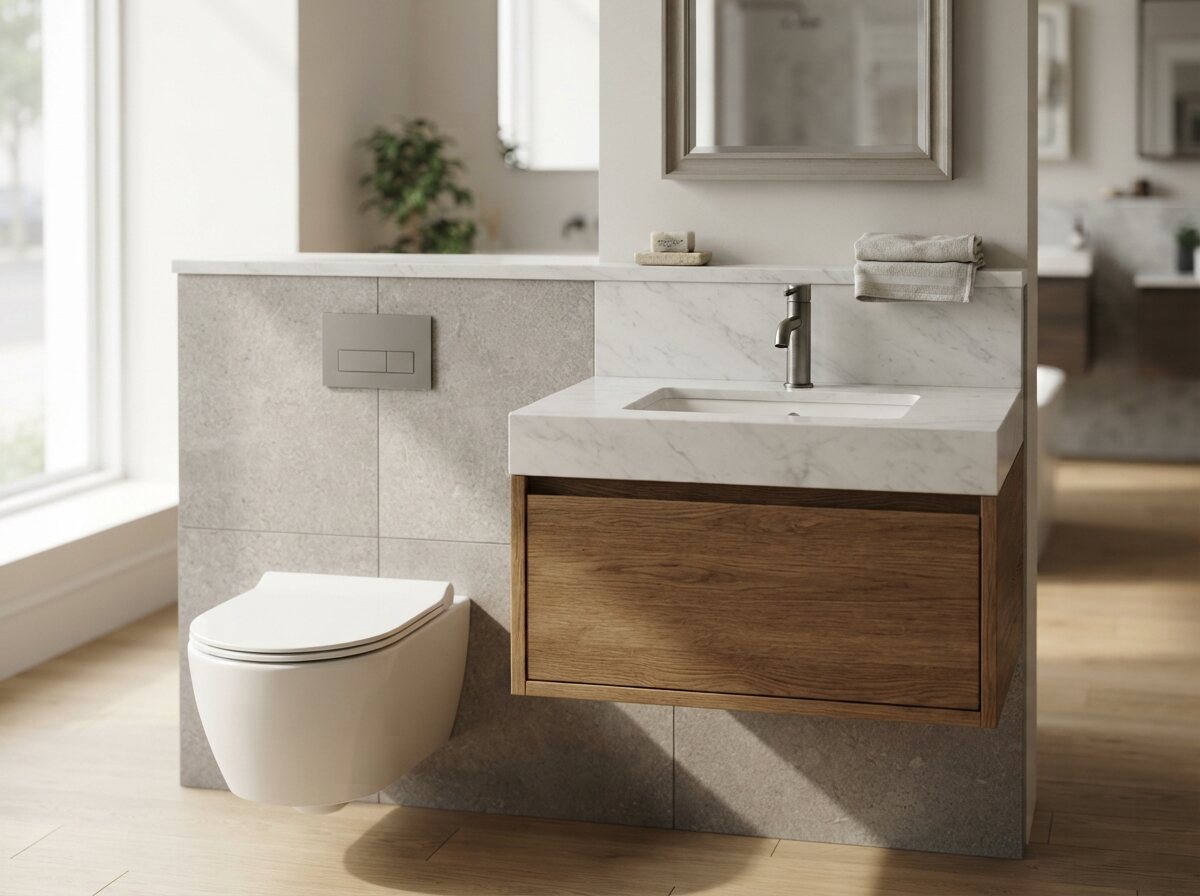
Bathrooms are where a container of building materials most often goes wrong in a small way – a toilet that does not fit the drain position, a tap with the wrong thread. All avoidable. Here is what we check in the showroom and again on the pro-forma, followed by what a typical order costs, how long it takes, and where to buy.
1. Rough-in and trap
Floor-mounted toilets are made for 305 mm (12”) or 400 mm rough-in with S-trap, or for wall outlet (P-trap) at 180 mm. Measure your drains before you travel.
This is the mistake we see most. Export models are usually 305 mm S-trap for the Americas and Middle East, P-trap for Europe and the UK, and 400 mm for parts of Asia and Australia. Most factories make the same bowl in two or three versions, but the version has to be on the pro-forma. For wall-hung toilets you also need the concealed cistern frame; buy it from the same source so the flush plate and outlet match.
2. Flush volume and system
Dual flush 3/4.5 L or 3/6 L; siphonic (quiet, common in the Americas) vs. washdown (Europe). Ask for the flush test video or do it in the factory.
Siphonic bowls have a larger water surface and a quieter flush; washdown bowls are simpler, clog less and use less water. Neither is better, but your market will expect one of them. In the showroom we ask the staff to flush with a handful of paper; a good bowl clears it in one flush every time.
3. Glaze inside the trapway
Look into the outlet with a torch. Good factories glaze the full trapway; cheap ones do not, and the bowl stains within months.
Also run a hand over the inside of the rim and the back of the bowl where the tank sits; rough patches there mean the factory is saving on glaze everywhere. A well-fired one-piece toilet rings when tapped, and the visible glaze has no pinholes or pooling. Ask what grade you are being quoted; export factories sell A grade, but the cheaper wholesale markets mix grades.
4. Seat and fittings
UF (urea) seats with soft-close and quick-release hinges; branded flush valves (Geberit, R&T, Wdi). Order 2–3% spare seats and valves.
A PP seat is lighter, yellows in sunlight and feels cheap; a UF seat is heavier, stays white and is worth the extra dollar or two. Flush valves are the part most likely to fail in the first year, which is why we insist on a named brand and spares. R&T and Wdi are Chinese brands used by many Western toilet makers and are fine. If the quote just says “quality fittings”, ask for the brand and check the box at inspection.
5. Basin overflow and tap holes
Confirm overflow presence, tap-hole count and spacing (single hole, 4” centreset, 8” widespread) against your faucet choice.
Basins and taps are usually bought from different factories, so nobody checks the match unless you do. Basins without overflow need a non-slotted waste; basins with overflow need a slotted one, so write the waste type on the order. For undermount basins, confirm the cut-out template is supplied, because your stone or cabinet supplier will need it before the basins arrive.
6. Faucet body and cartridge
H59 brass body, ceramic disc cartridge from a known brand, 35 or 40 mm; PVD finish for colours. Zinc alloy bodies are only for very low budgets.
A brass tap is noticeably heavier than a zinc one of the same design, which is the easiest showroom check. Ask about lead content if your market regulates it; low-lead brass costs a small premium. Coloured finishes (brushed gold, gunmetal, matt black) should be PVD, not lacquer, or they wear through at the handle within a year. Confirm the thread: G1/2 for most of the world, NPT for the US. Most taps sold in Foshan are made in Kaiping, an hour away; our page on Kaiping and Jiangmen explains when it is worth going there directly.
7. Certifications
If your market requires WaterMark, CUPC, SASO or CE, buy the model that already has the certificate and get a copy with your documents.
Certification is per model, not per factory. A factory with WaterMark on three toilets does not have it on the fourth, and certifying a new model takes months. Ask for the certificate number and check the model code on it matches your pro-forma.
8. Packing
5-layer cartons with moulded inserts; one-piece toilets individually crated for LCL. Check carton stacking limits are respected at loading.
Ceramics break at the corners, so the inserts matter more than the carton. For LCL shipments, where your goods share a container with other people’s, the loading is out of your control, so timber crates for toilets and basins are worth the extra cost. Expect 1–2% breakage on any ceramic shipment; a good factory will add a few spares if you ask.
Prices and MOQs: sanitary ware guide.
Typical prices and MOQs
Factory prices vary a lot with grade, design and quantity, so treat these as ranges rather than quotes. A standard A-grade one-piece toilet with UF seat and branded valve is in the region of USD 45–90 ex-works; two-piece and washdown models sit at the low end, rimless and wall-hung designs above it. Ceramic basins run from about USD 10–15 for a simple wall-hung or drop-in basin to USD 40–80 for larger countertop pieces. Brass basin mixers with a branded cartridge are usually USD 12–35 in chrome, with PVD colours adding 30–60%. Shower columns range from around USD 30 for a basic chrome set to USD 100 and more for thermostatic or coloured versions.
MOQs are lower than most buyers expect. Toilet factories typically ask for 20–50 pieces per model, sometimes less for a mixed container; basins similar. Tap factories usually want 50–100 pieces per model per finish, because PVD runs are batched. Below those numbers you can still buy, but from a wholesale showroom at 15–30% more. For a villa with four or five bathrooms, the practical route is one toilet model, one or two basin designs and one tap range across the house, which meets the MOQ and looks better anyway.
Lead times
Ceramic items from a factory’s current range are normally 20–35 days from deposit. New colours or moulds take 45–60 days. Brassware is 25–40 days, longer for PVD finishes and special threads. When toilets, basins and taps come from three factories for one container, we schedule the orders to finish in the same week and consolidate them at one warehouse before loading; the shipping page covers how that works. Add three to four weeks if any part of the order runs over Chinese New Year.
Chaozhou or Foshan?
Chaozhou, in eastern Guangdong, makes more ceramic sanitary ware than anywhere else in China, and most of the toilets in Foshan showrooms come from there. Foshan’s strength is as a market: hundreds of showrooms in one city, brassware from nearby Kaiping, and the ability to see toilets, tiles, cabinets and lighting in the same two days.
Our rule of thumb: if sanitary ware is a small part of a mixed container, buy it in Foshan, accept a modest margin over factory price and save a day’s travel each way. If you are ordering several hundred toilets or building a range to import repeatedly, go to Chaozhou and buy from the factory. There is more on this at Chaozhou vs Foshan for sanitary ware, and the market guide lists which areas of Foshan to walk for bathrooms.
What a typical order looks like
For a ten-bathroom boutique hotel the list was: ten wall-hung rimless toilets with concealed cisterns and plates, ten countertop basins, ten basin mixers, ten thermostatic shower sets and ten floor drains, brassware all in brushed gold PVD, plus 3% spares on seats and valves. Three factories, one consolidation, a bit over a quarter of a 20 ft container, and roughly a third of the price quoted at home. We checked drain positions against the plumber’s drawings before the deposit, the one step that cannot be skipped.
A note on prices: every figure in this guide is an indicative estimate from recent orders. Factory prices, freight rates and exchange rates move, so treat them as a planning guide and ask us for a current quote before you budget.
Frequently asked questions
Can I mix items from different factories in one container?
Yes, and almost every order does. The factories deliver to a consolidation warehouse near the port, where everything is checked and loaded together. Toilets from Chaozhou, taps from Kaiping and tiles from Foshan in one box is routine.
Are the toilets sold under Western brands the same ones?
Often the same factory, sometimes the same mould, but not always the same specification. Brands specify their own glaze, valve and packing. You can specify the same things; you just have to write them down.
What if a toilet arrives broken?
Photograph it in the carton before moving it. A factory will normally credit breakage above the usual 1–2% against the next order, but will not ship a single replacement toilet by sea. This is why we order spares.
Do I need to come in person?
A softer yes than for windows. Standard models can be bought on samples and photographs, but glaze, weight and finish differences between price points are much easier to judge in a showroom, and a two-day trip usually covers bathrooms alongside everything else.
Can I get the toilet, basin and tap in matching colours?
Ceramic colours (matt black, grey, beige) vary slightly between factories, so buy all coloured ceramics from one source. PVD tap colours are more consistent, but ask for a sample of each finish from each factory and compare them side by side before ordering.
Planning to buy building materials in Foshan?
Tell us what you need and when you plan to come. We aim to reply the same business day with a realistic plan, price ranges and which markets to visit.